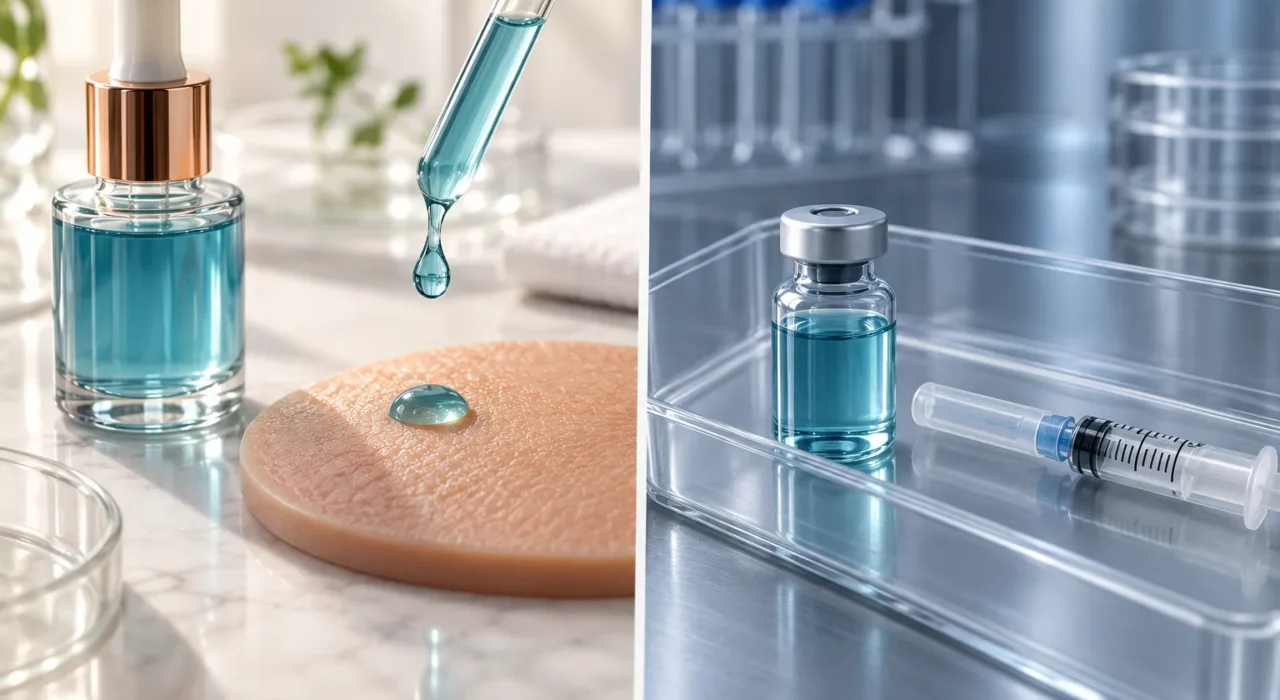
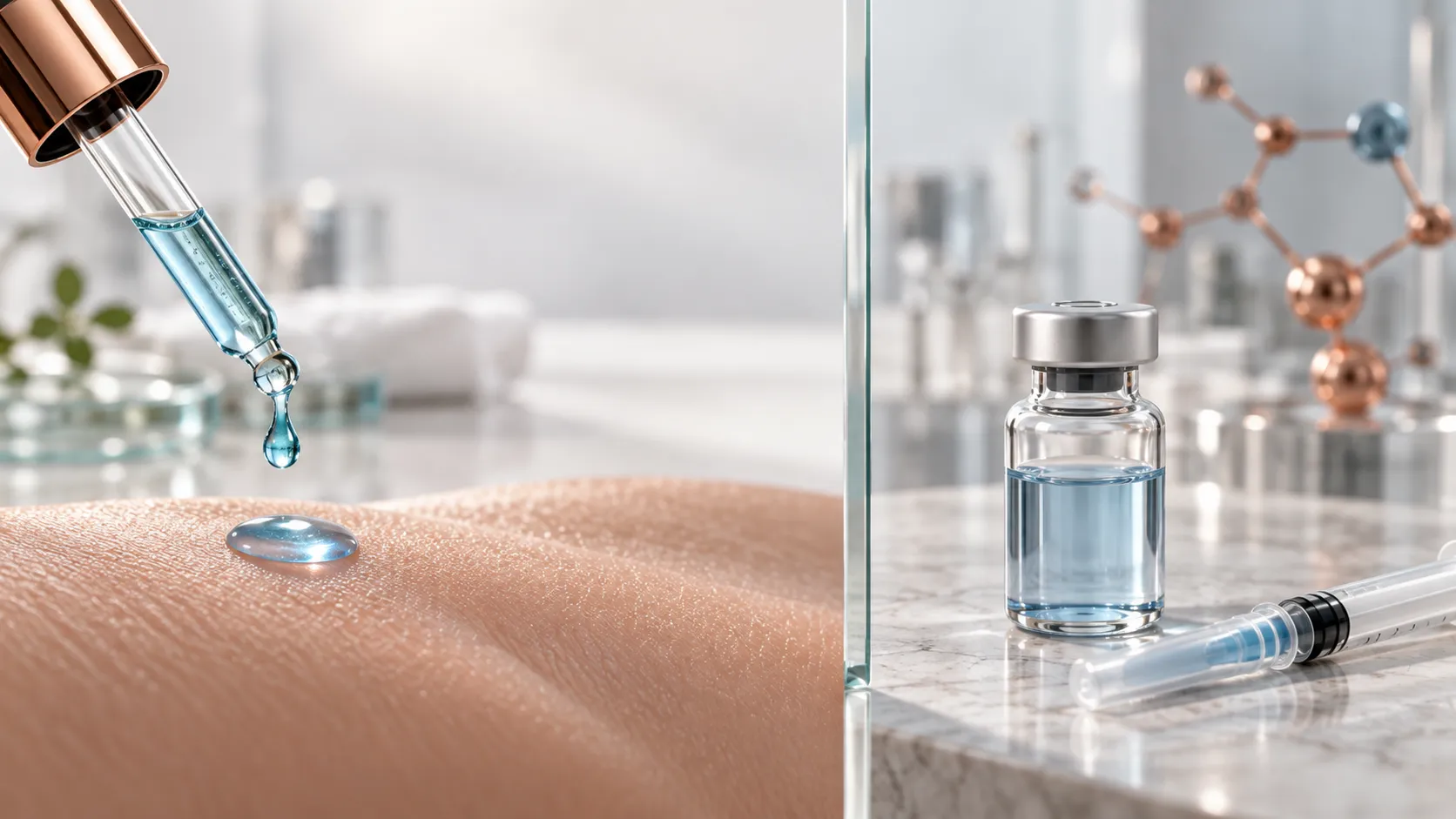
Copper peptides are everywhere right now — skincare shelves, TikTok, and increasingly, needles. That last part is the problem. Search interest in “copper peptide injections” has spiked, people are buying vials from research-chemical websites and self-injecting at home, and the wellness-clinic reports coming out of that trend include elevated liver enzymes and copper overload. That’s not scaremongering — that’s what happens when a genuinely well-studied molecule gets used through a route nobody has actually tested.
So we should really be having two separate conversations here, because putting this on your skin and injecting it into your body aren’t the same question at all.
What GHK-Cu actually is
GHK-Cu — glycyl-histidyl-lysine bound to copper — is a naturally occurring tripeptide-copper complex your body already produces. Levels are highest in your twenties and decline steadily after, which is part of why it’s been studied for decades in wound healing and skin ageing. It’s not a novel synthetic compound chasing a trend; it’s one of the more mechanistically interesting molecules in the peptide space. Which is exactly why it deserves better than being used carelessly.
What topical GHK-Cu does in the skin
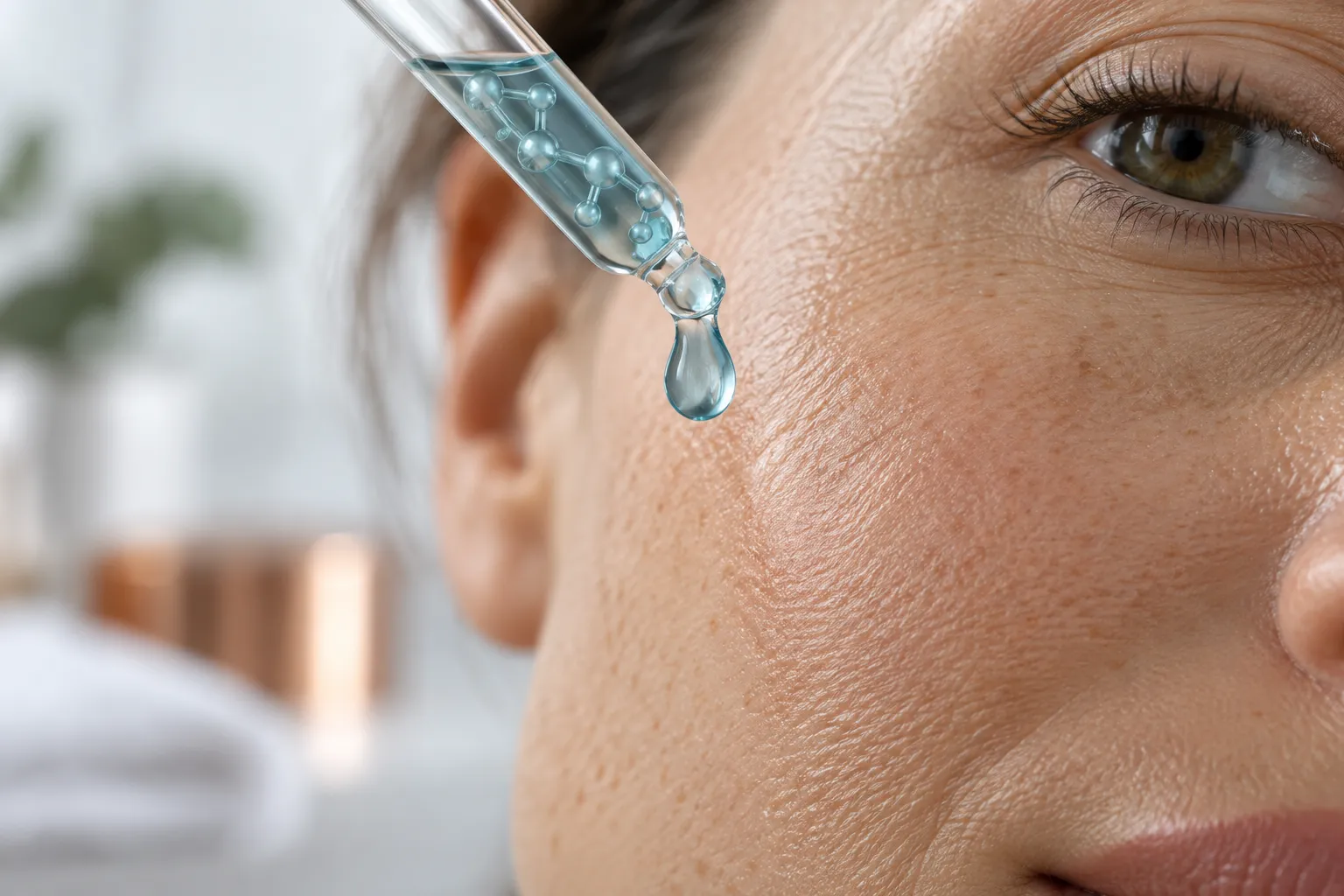
Topically, the evidence is genuinely solid. GHK-Cu works as an antioxidant — it mimics one of the body’s own defence enzymes (superoxide dismutase) that mops up free radicals, the unstable molecules that damage skin cells over time and speed up ageing. It also calms the low-level, chronic inflammation that quietly ages skin in the background, sometimes called “inflammaging.” On top of that, it blocks MMPs — enzymes that chew through your existing collagen — while switching on fibroblasts, the cells in your skin responsible for manufacturing new collagen, elastin, and the water-binding molecules (glycosaminoglycans) that keep skin plump and hydrated.
Even the bit about MMPs is simplified. GHK-Cu actually modulates MMP levels because you do need them to break down old, damaged collagen. Just like growth factors, this amazing ingredient is also about restoring balance, rather than just blindly reducing or elevating levels of certain proteins. So, with regards to collagen, you’re getting less breakdown and more production from the same ingredient, at the same time.
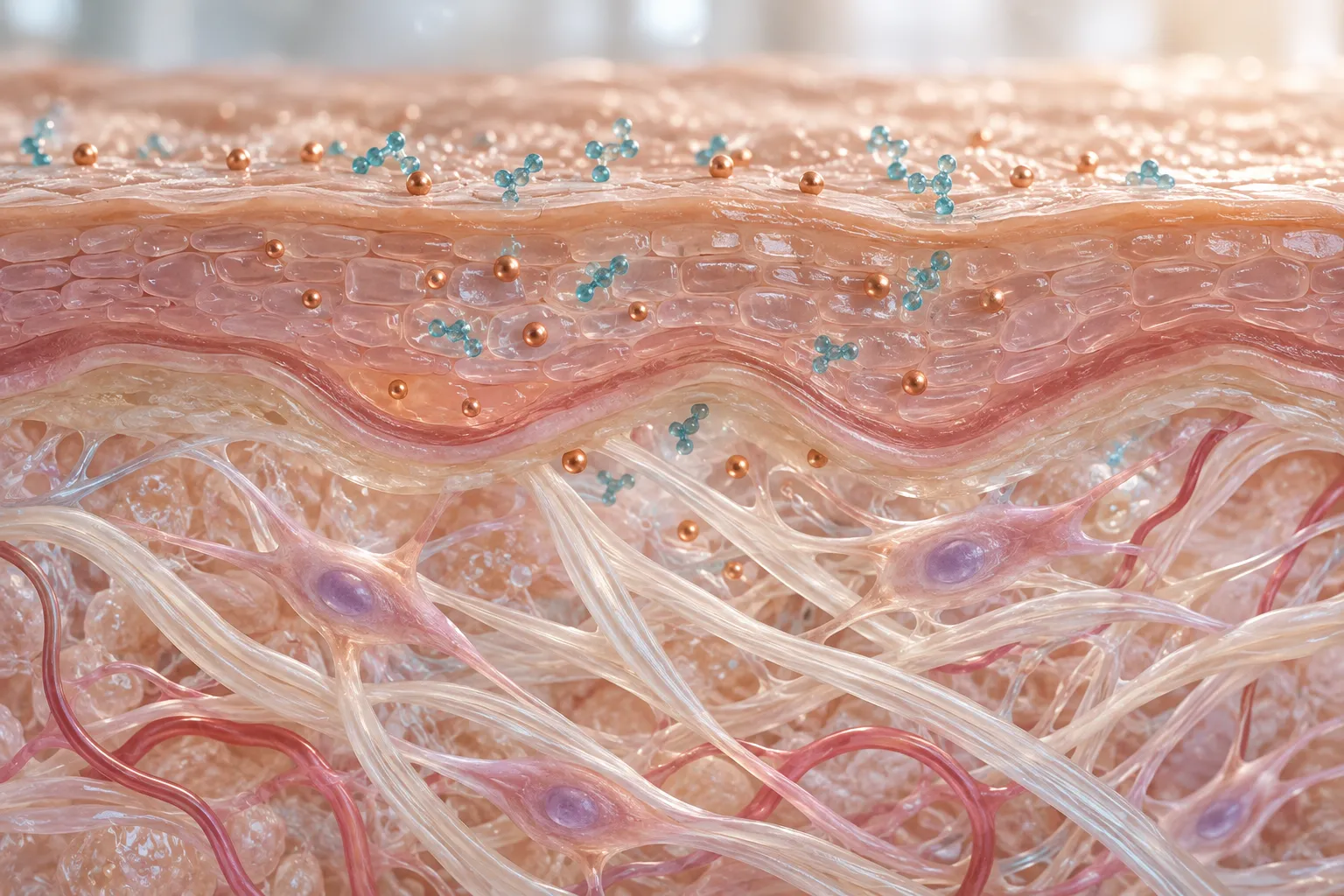
There’s also a solid body of research, much of it from Loren Pickart’s original work, showing GHK-Cu can influence which genes skin cells switch on and off — turning up repair, turning down inflammation. That’s an unusual level of activity for a cosmetic ingredient, and it’s a big part of why dermatologists who are sceptical of most trending actives still rate this one.
Multiple controlled human trials — some independently funded, some by ingredient suppliers — show topical GHK-Cu improving skin thickness, firmness, and fine lines over a period of weeks to months. It sits in the same evidence tier as retinoids or vitamin C: not hype but established science.
Where it goes wrong: injecting it
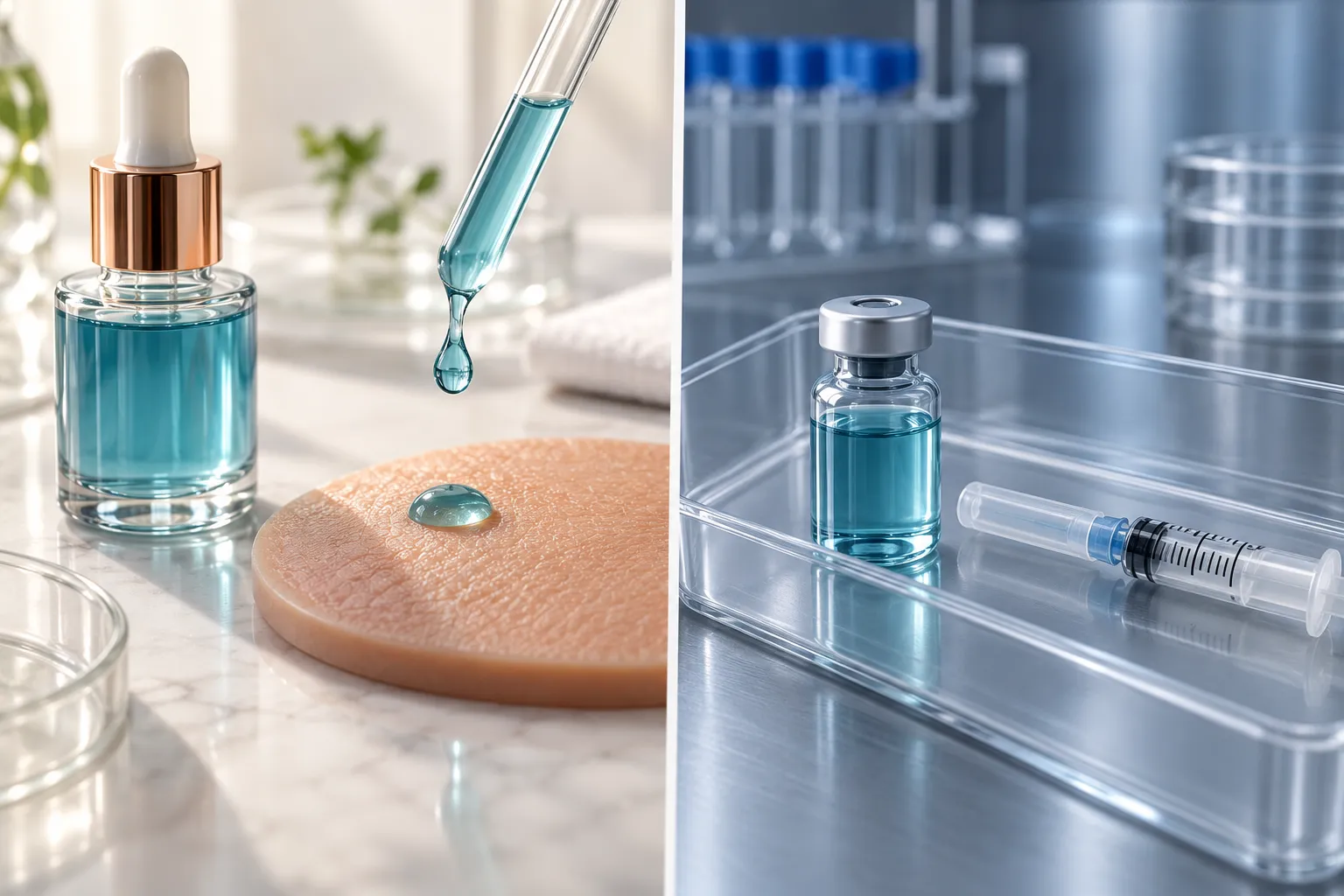
None of that evidence transfers to injection. Not because the molecule is inherently dangerous, but because nobody has run adequate human studies. There is no published data on injectable dosing, no established safe serum-copper threshold for repeated injection, no data on what happens when you bypass the skin barrier that was previously limiting systemic absorption.
What’s happening instead is people buying “research use only” copper peptide vials online — often stacked with other unregulated peptides — and self-administering with no medical oversight. Clinicians treating the fallout have reported injection-site infections and, more seriously, bloodwork showing elevated liver enzymes alongside elevated serum copper, consistent with copper overload from repeated, unmonitored dosing. Copper is essential in trace amounts and genuinely toxic in excess — the body has a narrow window for clearing it safely, and injecting removes the barrier that made topical use forgiving in the first place. Add unregulated sourcing, with no sterility guarantee and no verified concentration in the vial, and you have a real, documented safety signal, not a hypothetical one.
The honest framing isn’t “copper peptides are dangerous.” It’s that the route of administration is what is untested, and the people reporting harm right now are the ones who found that out first-hand.
Why topical use is a different conversation entirely
Applied to skin, GHK-Cu’s absorption is self-limiting by design. The stratum corneum does its job — you get the antioxidant, anti-inflammatory, and collagen-supporting effects at the surface and upper dermis without meaningfully shifting serum copper. That’s the whole point of a well-designed topical: the benefit without the systemic exposure. It’s why the same ingredient that raises legitimate red flags injected can be one of the more defensible actives in a formulated serum.
For a wider practitioner perspective on why evidence from cosmetic use cannot justify systemic injection, read Aesthetic Medicine’s review of topical copper peptides and injectable GHK-Cu.
Where GF5 Next Generation fits
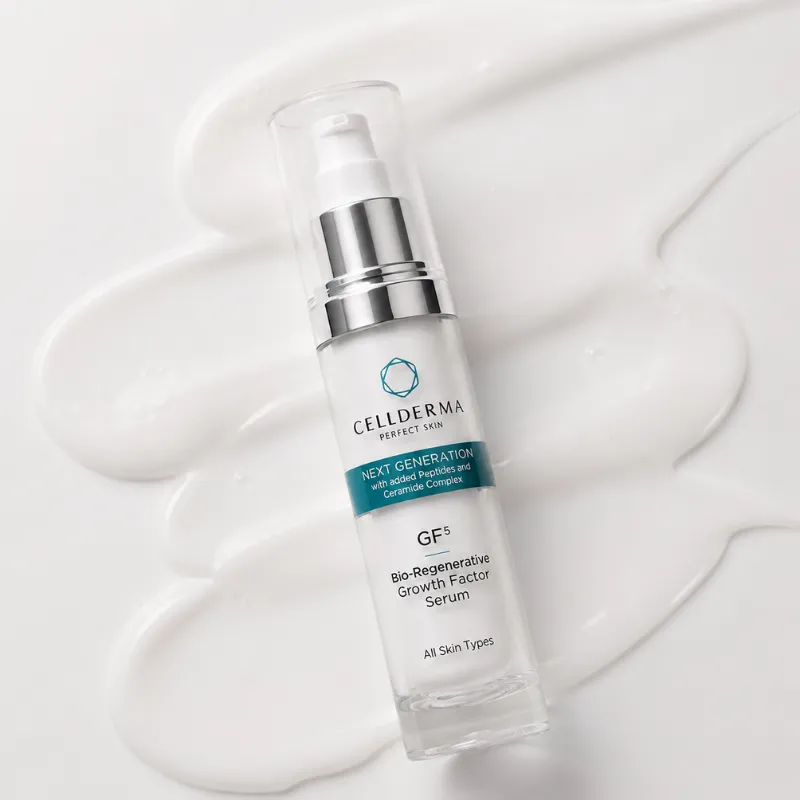
GF5 Next Gen includes Copper Tripeptide-1 as part of a five-peptide growth-factor complex, alongside ceramide-based barrier support and Acetyl Hexapeptide-8, plus other peptides and actives. It isn’t a copper-peptide product with everything else as decoration — copper tripeptide-1 is doing a specific, evidenced job (antioxidant and anti-inflammatory support, stimulating dermal matrix production) inside a formula built around that mechanism, not instead of it.
Why we do not publish the percentage
We don’t publish the percentage, and that’s deliberate, not evasive. Every raw-material supplier sets a recommended functional range for their specific form of an ingredient — a lowest level that does something and a highest level that’s stable, safe, and effective in a finished formula. Those ranges differ by supplier, by the exact molecule form, and by what else is in the formula around it, which means a bare percentage on a label tells you almost nothing without that context.
It’s also exactly the kind of number that gets misused across this industry, with brands quoting a headline figure that bears no relation to what their supplier actually recommends or to what the ingredient does at that level in that formula. We’re not entering that percentage war.
What we will say plainly: GF5 Next Gen uses copper tripeptide-1 at the top of the functional range recommended for the specific form and brand of the ingredient we use — not a trace, label-decoration amount, and not a number chosen to win a marketing argument rather than do something in the formula. In clinical use, that’s shown up as consistent, cumulative improvement in skin quality over sustained use, which is the honest way to describe what a well-formulated topical peptide should do: gradual, not overnight.
The bottom line: If a copper peptide product is going on your skin, the science backing it, is some of the best in skincare. If it’s going into a needle you bought online, you’re part of an unofficial study without the safety oversight!
Frequently asked questions
What is GHK-Cu?
GHK-Cu is glycyl-histidyl-lysine bound to copper, a naturally occurring tripeptide-copper complex that the body already produces. Researchers have studied it for decades in relation to wound healing and skin ageing. Its topical activity includes antioxidant, anti-inflammatory and dermal-matrix support.
Are topical copper peptides the same as injectable GHK-Cu?
No. Topical copper peptides act through the skin, where the stratum corneum limits systemic absorption. Injection bypasses that barrier and changes the body’s exposure. Evidence and decades of cosmetic experience relating to topical use cannot simply be extrapolated to justify systemic injection.
Is injectable GHK-Cu proven safe?
No adequate human studies have established injectable dosing, a safe serum-copper threshold for repeated injection or the effects of bypassing the skin barrier. Unregulated sourcing also introduces concerns about sterility, concentration and use alongside other research peptides.
Why does GF5 Next Generation not publish its Copper Tripeptide-1 percentage?
A percentage has little meaning without the supplier’s functional range, the exact molecular form and the surrounding formula. GF5 Next Generation uses Copper Tripeptide-1 at the top of the recommended functional range for the specific form and brand used, rather than as a trace label claim.
Sources and further reading
- NPR: “The copper peptide trend has gone from creams to injections, ahead of the science”, 7 September 2026.
- Pickart and Margolina: “Regenerative and Protective Actions of the GHK-Cu Peptide in the Light of the New Gene Data”.
- Aesthetic Medicine: “What does the evidence say about copper peptide injections for aesthetic treatments?”, updated 15 September 2026.