
Why Skin Actually Ages (It’s Not What You Think) And Where Growth Factors Fit In
For years, the story of skin ageing has been simple: your cells wear out. Collagen production supposedly grinds to a halt, your skin’s repair “battery” runs flat, and there’s nothing to do but replace what’s lost.
New research says that story is wrong, or at least incomplete.
Our founder, Dr Dev Patel, recently examined this in a peer-reviewed article published in the Journal of Regenerative Aesthetic Medicine, titled “Loss of Biological Synchrony in Skin Ageing.” The central idea: skin cells largely keep their ability to repair and regenerate, even in older skin. What breaks down isn’t the machinery; it’s the timing and coordination between the systems that tell that machinery what to do, when.
That distinction matters, because it changes what “anti-ageing” skincare should actually be trying to do.
Your Skin Was Built to Run on a Schedule
Healthy, youthful skin isn’t a static barrier; it’s constantly repairing itself in a highly choreographed sequence. When skin is injured (even by everyday sun exposure or minor damage), a precise chain of events unfolds: inflammation clears debris, growth factors summon new cells to the site, and once the repair is done, the inflammation switches itself off.
This entire process even runs on a daily rhythm. Much of skin’s repair work, including DNA repair, barrier rebuilding and antioxidant activity, happens disproportionately overnight, governed by the body’s internal clock genes.
What Goes Wrong as Skin Ages
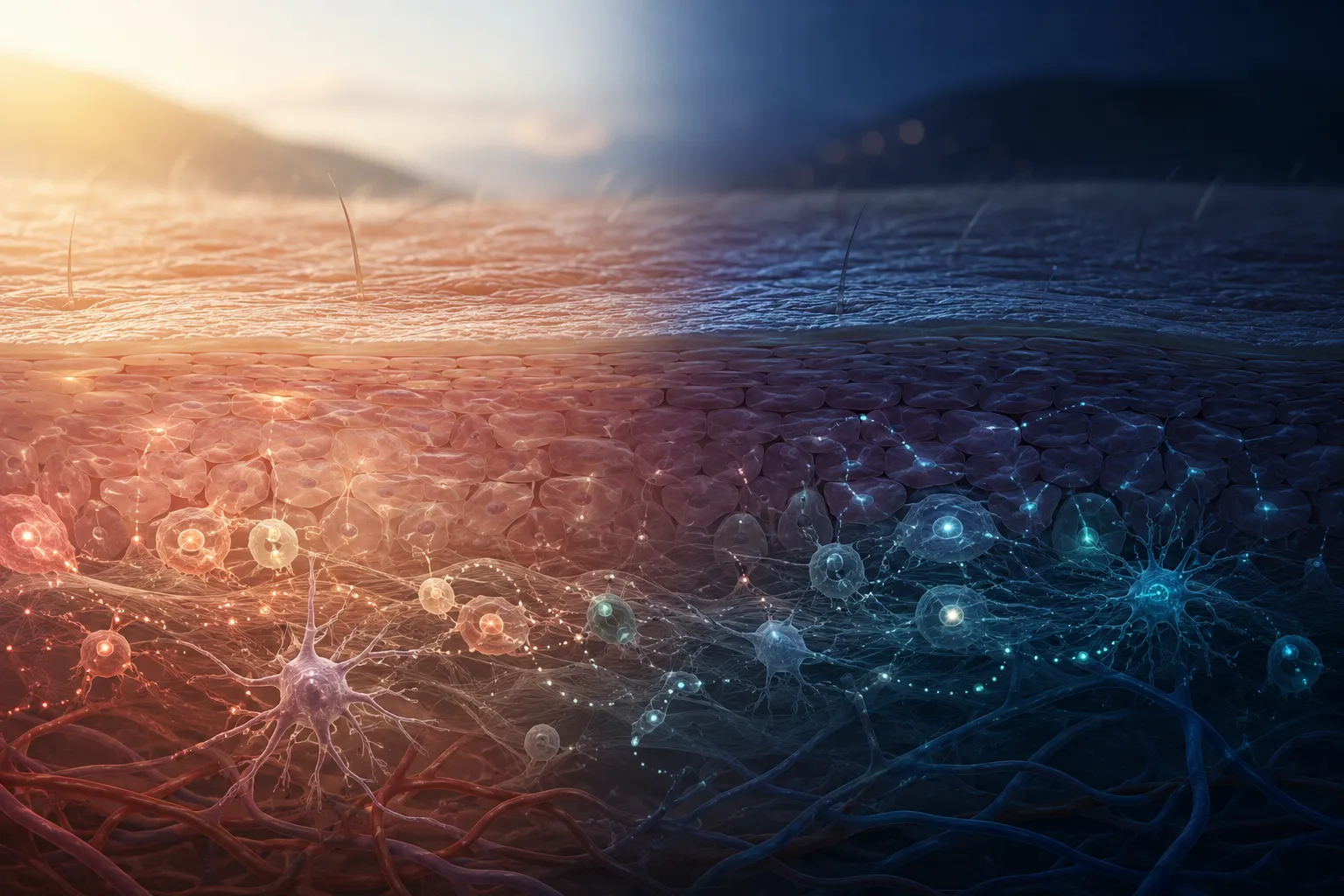
As skin ages, this choreography starts to slip:
- Inflammation doesn’t switch off properly. Low-grade inflammation lingers in the background, a phenomenon researchers call “inflammaging”, creating chronic, low-level stress on tissue.
- “Retired” cells cause active damage. Senescent cells (cells that have stopped dividing but haven’t died) don’t just sit quietly. They actively secrete inflammatory signals and enzymes that disrupt their neighbours, creating a feed-forward loop that spreads dysfunction rather than containing it.
- Growth factor signals get muffled. Skin cells become less responsive to the repair signals still being sent, so regeneration becomes patchy, delayed, or incomplete.
- The overnight repair shift shortens. As circadian rhythms in skin lose their sharpness with age, nightly repair becomes less efficient, and oxidative damage has more time to accumulate.
The result isn’t that skin stops trying to repair itself. It’s that repair becomes mistimed, running alongside ongoing breakdown rather than resolving it. That’s what shows up on the surface as fine lines, uneven pigmentation, slower barrier recovery, and a duller overall texture.
So What Are Growth Factors, Exactly?
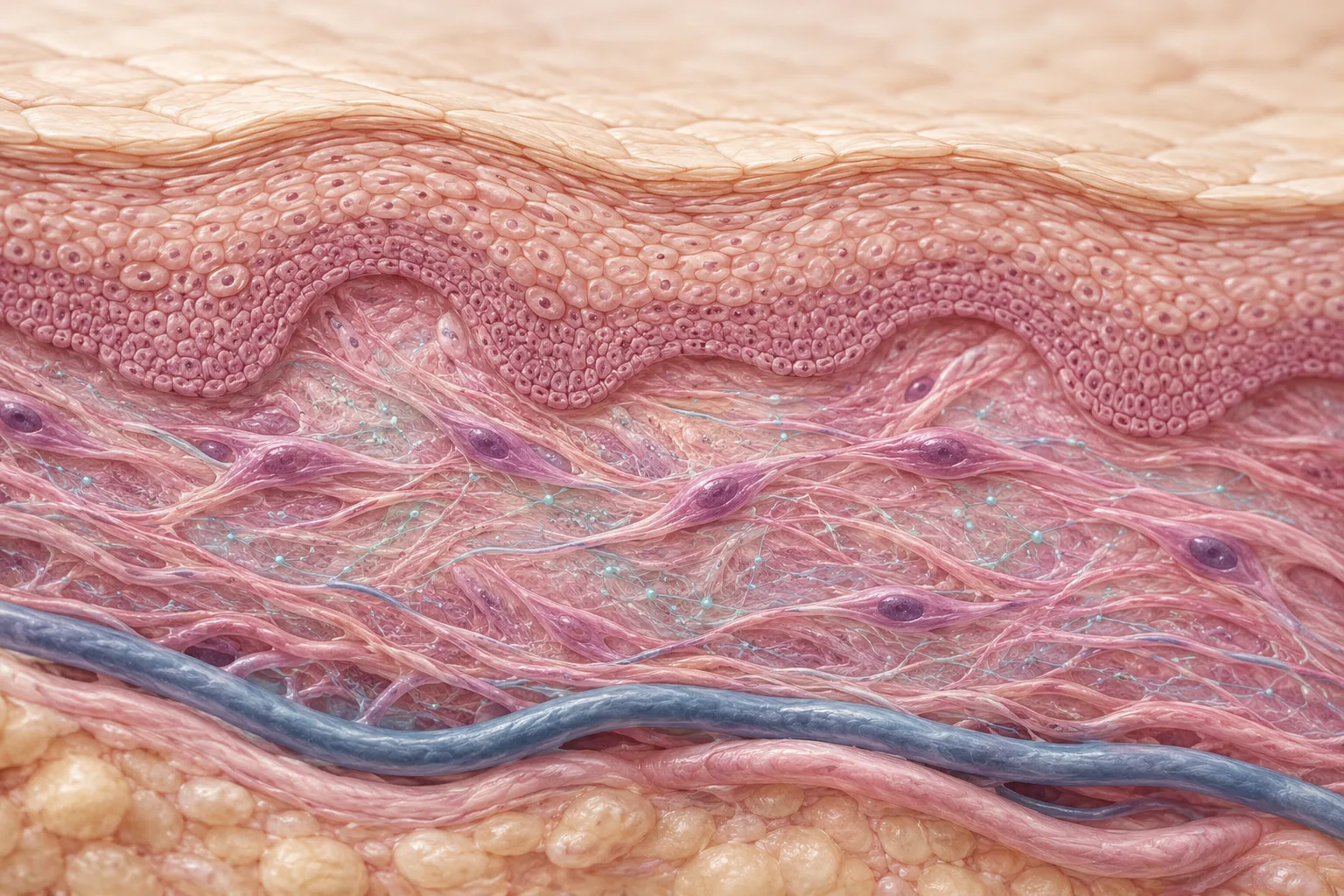
Growth factors are naturally occurring proteins that act as messengers between skin cells. Think of them as the instructions that tell your skin’s repair crew what to build, where, and when. A few key ones:
- EGF (Epidermal Growth Factor): signals skin cells to divide and renew the outer layer.
- FGF (Fibroblast Growth Factor): supports the cells responsible for producing collagen.
- VEGF (Vascular Endothelial Growth Factor): supports blood vessel formation, which feeds the repair process with oxygen and nutrients.
- IGF-1 (Insulin-like Growth Factor 1): supports cell survival and tissue growth signalling.
Your skin makes these naturally your whole life. The issue with ageing skin isn’t usually a total absence of growth factors (however, natural production declines significantly from childhood onwards; this is well-established biology); it’s that the signalling around them becomes weaker, delayed, or drowned out by chronic inflammation. This is why growth factor-based skincare is formulated around the idea of reinforcing existing signals, not replacing skin’s ability to function.
Where GF5 Fits Into This
GF5 was developed by Dr Patel around this exact regulatory-breakdown model of ageing rather than the older “just replace what’s lost” approach. Instead of one isolated ingredient, GF5 combines multiple regenerative signalling peptides designed to work with skin’s own repair pathways, including peptide-based ingredients that support the same VEGF and FGF pathways referenced above, alongside a peptide that helps calm the inflammatory signalling associated with skin sensitivity and stress.
We’re deliberately cautious about how we describe this. GF5 is positioned as a daily regenerative support formula and a complement to in-clinic procedures, something that supports skin’s own repair signalling, particularly when skin is already in a repair state (post-procedure, barrier-compromised, or environmentally stressed). The evidence base for growth factor skincare spans over 25 years of research and is genuinely encouraging, though, like most of regenerative aesthetics, it’s still developing. We’d rather underclaim than overpromise. That said, hundreds of case observations and testimonials from clinics and consumers using GF5 add real-world weight alongside the published science.
The Bigger Picture
This reframes what “anti-ageing” skincare should really be aiming for. Instead of chasing volume replacement or aggressive exfoliation alone, the more interesting long-term question is: can we help restore the timing and coordination of skin’s own repair systems? That’s the thinking behind CellDerma’s approach: supporting biology, not overriding it.
FAQs
Is skin ageing caused by cells “running out” of collagen-making ability?
Not primarily. Research increasingly shows fibroblasts (the cells that produce collagen) largely retain the ability to make collagen well into later life. The bigger issue is that this production gets outpaced by ongoing enzymatic breakdown and disrupted signalling.
What is “inflammaging”?
It’s the term used for the low-grade, chronic inflammation that builds up in tissue over time, rather than the short, resolving bursts of inflammation seen in youthful skin repair. It’s considered one of the key drivers of visible skin ageing.
Do growth factors in skincare actually get absorbed and do anything? Aren’t they too big to penetrate skin?
You’ll see this claim a lot: that any molecule over 500 Daltons is too large to pass through skin. It’s not wrong, but it’s incomplete; it only applies to intact, undamaged skin barrier. Photodamaged, inflamed, or barrier-compromised skin behaves differently, allowing larger molecules through far more readily. This is even more true immediately after in-clinic procedures, where the barrier is deliberately disrupted, exactly when growth factor support is often most relevant.
But even on fully intact skin, growth factors don’t need to penetrate deep to produce a clinical effect. Growth factors primarily act on surface-level skin cells, which then respond by releasing their own downstream signalling molecules: messengers that propagate the repair signal further into the tissue. This relay mechanism, sometimes called the double paracrine effect, is why topical growth factor formulas can produce measurable benefits without the original molecule ever needing to cross the full depth of the skin barrier itself.
Is GF5 a substitute for in-clinic treatments?
Not usually. GF5 is formulated as a daily-use support product, with particular relevance around procedures where skin is actively in a repair phase. It’s not marketed as a replacement for energy-based devices or injectable treatments. That said, for those who cannot or do not wish to have in-clinic treatments, GF5 does provide a potentially impressive solution for skin rejuvenation.
Why does nighttime skincare matter so much?
Skin’s repair processes, including DNA repair and barrier rebuilding, are disproportionately active overnight, governed by the body’s circadian clock genes. This is part of why consistent night-time skincare routines are emphasised in regenerative skincare science.
Selected References
- Rittié L, Fisher GJ. Cold Spring Harb Perspect Med. 2015;5:a015370.
- Quan T, et al. J Investig Dermatol Symp Proc. 2009;14:20–24.
- Furman D, et al. Nat Med. 2019;25:1822–1832. (Inflammaging)
- Coppé JP, et al. Annu Rev Pathol. 2010;5:99–118. (Senescence-associated secretory phenotype)
- Wiley CD, et al. Cell Metab. 2016;24:87–98.
- Plikus MV, et al. Nature. 2012;490:209–214. (Circadian regulation of skin)
- Geyfman M, et al. J Invest Dermatol. 2015;135:1202–1207.
- Schultz GS, et al. Adv Wound Care. 2011;1:78–84. (Growth factors in wound repair)
- Fisher GJ, et al. Arch Dermatol Res. 2002;294:191–197.
- Patel D. “Loss of Biological Synchrony in Skin Ageing.” Journal of Regenerative Aesthetic Medicine, May 2026, pp. 48–51.
This article is for educational purposes and reflects current scientific understanding of skin biology. It is not intended as a substitute for personalised clinical advice.