PDRN vs Exosomes vs Growth Factors in Skincare
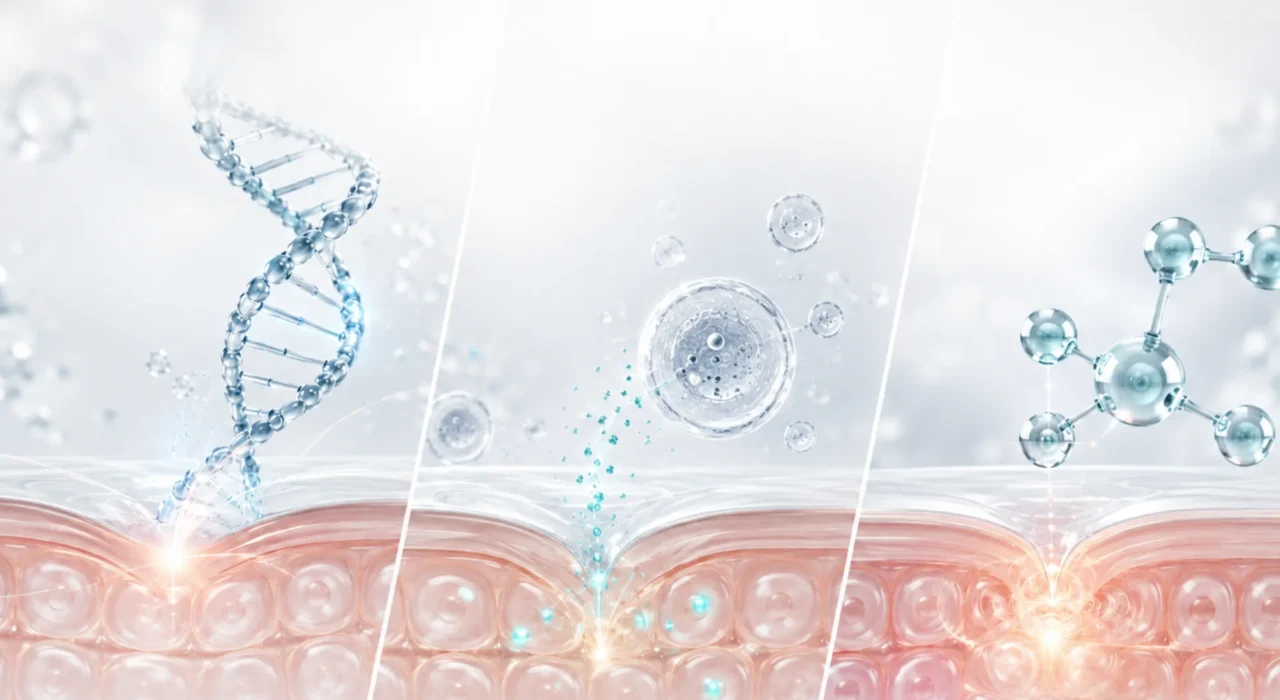
Quick answerWhen comparing PDRN vs exosomes vs growth factors in skincare, it is important to understand that they are three distinct regenerative technologies. PDRN consists of purified DNA-derived fragments; exosomes are extracellular vesicles involved in cell-to-cell communication; and growth factors are signalling proteins that regulate cellular processes. The most important question is not which term sounds most advanced, but what the material is, how it is delivered, whether the evidence applies to topical skincare and whether the finished product has been tested.
PDRN vs exosomes vs growth factors in skincare: quick comparison
| Technology | What it is | Main biological concept | Key evidence question |
|---|---|---|---|
| PDRN | Purified DNA-derived fragments | Nucleotide-related biological pathways | Is the evidence topical, injectable or medical? |
| Exosomes | Extracellular vesicles carrying biological material | Cell-to-cell communication | How were they sourced, characterised and stabilised? |
| Growth factors | Defined signalling proteins | Regulation of cellular and extracellular-matrix activity | Are the factors defined, stable and tested in the finished formula? |
Why regenerative skincare terminology matters
Regenerative skincare is one of the fastest-growing beauty conversations, but its language is often blurred. Consumers see PDRN, exosomes, polynucleotides, stem-cell media, peptides and growth factors discussed as if they were interchangeable. They are not.
When I assess any regenerative skincare technology, I ask four questions: what exactly is the active material, is the evidence topical, injectable or medical, has the finished formula been tested, and are the claims proportionate to that evidence?
What is PDRN in skincare?
PDRN stands for polydeoxyribonucleotide. It is a mixture of purified DNA-derived fragments, generally composed of chains of deoxyribonucleotides within a specified molecular-weight range. It is not one single molecule, and its source, manufacturing process and material specification can vary.
Although PDRN and polynucleotides are closely related DNA-derived materials, the terms are not always used consistently across cosmetic products, injectable treatments and scientific literature. The exact material and method of use should therefore be checked.
PDRN has been researched in regenerative medicine and tissue-response settings, but that does not mean every topical PDRN serum has the same evidence. A cosmetic product used on intact skin is not equivalent to an injectable treatment or a medical application. Formulation, concentration, stability, delivery and finished-product testing all matter.
What are exosomes in skincare?
Exosomes are extracellular vesicles involved in cell-to-cell communication. In plain English, they are microscopic packages that can carry biological material between cells. This is why they are being explored in dermatology, wound-repair research and aesthetic medicine.
The word exosome can also be used loosely in beauty marketing. Products described with this term may differ substantially in source, purification, characterisation, stability and actual extracellular-vesicle content. Some may instead contain conditioned media, broader extracellular-vesicle preparations or exosome-associated ingredients. A cosmetic product should therefore not be judged by the word exosome on the label alone.
What are growth factors in skincare?
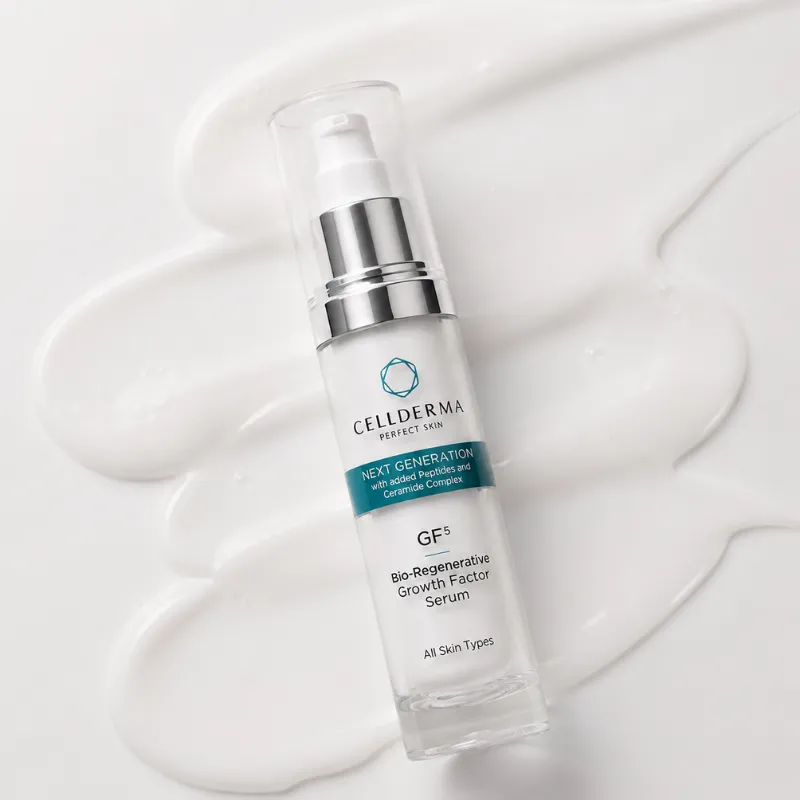
Growth factors are signalling proteins that help regulate processes including cell proliferation, renewal and extracellular-matrix activity. At CellDerma, GF5 Next Generation is formulated around five bio-identical growth factors: EGF, IGF-1, bFGF, VEGF and aFGF.
The growth factors used in GF5 are produced through a bio-culture process and are not sourced from human or animal tissue. In a four-week instrumental assessment using GF5 on the face and neck, DermaLab probe measurements showed a 56% increase in measured skin elasticity and a 102% increase in measured skin hydration from baseline at week four. This was a small finished-product assessment, and individual results may vary.
Study information Four-week, single-group instrumental assessment; complete GF5 formula used on the face and neck; elasticity measured using a DermaLab elasticity probe and hydration measured using a DermaLab moisture probe.
How should you assess regenerative skincare?
Whatever the headline technology, the evidence should match the product and the way it is used. I would ask:
- What exactly is the active material?
- Is the evidence based on topical cosmetic use, injection or a medical setting?
- Has the finished formula been tested, rather than only the headline ingredient?
- Are the claims cosmetic and proportionate to the size and design of the evidence?
My view as the founder of CellDerma
I have never believed CellDerma should chase every new trend word. Our position is evidence-led regenerative skincare, particularly through GF5 and growth factor technology. GF5 Next Generation is not a PDRN or exosome product. It is a growth factor serum supported by peptides including copper tripeptide-1, ceramides, folic acid ferment extract and many more actives.
The most credible regenerative skincare is not necessarily the product using the newest term. It is the product that defines its technology clearly, formulates it appropriately and supports its claims with relevant finished-product evidence.
PDRN, exosomes and growth factors: what to remember
- PDRN, exosomes and growth factors are related by theme, not by identity.
- PDRN and polynucleotide terminology can vary, so the exact material should be checked.
- Topical skincare evidence should be distinguished from injectable and medical evidence.
- Finished-product evidence matters more than ingredient popularity.
- GF5 is a bio-regenerative growth factor serum, not a PDRN or exosome product.
Frequently asked questions
Is PDRN the same as a growth factor?
No. PDRN is a DNA-derived material, while growth factors are signalling proteins. They may both be discussed in regenerative skincare, but they represent different biological concepts and should not be treated as interchangeable ingredients.
Are exosomes the same as stem cells?
No. Exosomes are extracellular vesicles involved in cell-to-cell communication. They are not living stem cells. In skincare, the source, processing, characterisation, stability and evidence behind an exosome-labelled product are important. It is also worth noting that most, but not necessarily all, exosomes marketed in skincare are not true exosomes.
Does CellDerma GF5 contain PDRN or exosomes?
No. GF5 Next Generation is a growth factor serum. Its formula contains five growth factors alongside peptides, ceramides, sodium hyaluronate and ferment extract; it does not contain PDRN or exosomes.
Which is best for supporting visible skin recovery and renewal?
The evidence base is probably strongest for growth factors. However, there is no single best category for every person or concern. I would look for a clear mechanism, appropriate delivery, good tolerability and relevant evidence for the finished formula, rather than relying on the popularity of one ingredient.
Can a growth factor serum be used after microneedling, RF microneedling, laser or chemical peels?
This depends on the manufacturer’s instructions for use. Growth factors have been shown in a number of studies to accelerate healing post-procedure, improve outcomes and improve skin resilience ready for treatment. GF5 Next Generation may be included within an approved peri-procedure routine for microneedling, RF microneedling, laser and chemical peels under the advice of a suitably qualified practitioner. The timing depends on the treatment type, skin type and practitioner protocol, so the treating clinician’s instructions and the device manufacturer’s aftercare guidance should take priority.
Numerous renowned energy-based device companies have adopted CellDerma GF5 as their chosen peri-procedural product, in the interest of patient safety and improved outcomes.